My role
Designed and validated the engine architecture, with the test stand, plumbing and data acquisition developed alongside it.
Tools used: Fusion 360 ANSYS selective laser melting
A hybrid whose nozzle, injector and fuel grain swap independently in under five minutes.
Challenge
One engine, many tests, consistent geometry.
The project set out to reduce cost, waste and experimental variability in propulsion research.
Its core objective was to replace single-use hybrid engines with a modular system that allows rapid iteration while keeping the chamber geometry and thermal boundary conditions consistent.
Design
Cooled by its own oxidizer, with a printed 316L nozzle.
The engine is regeneratively cooled and uses nitrous oxide as both oxidizer and coolant, with channeled cooling in a selectively laser-melted 316L stainless steel nozzle and a coaxial shell-cooled combustion chamber.
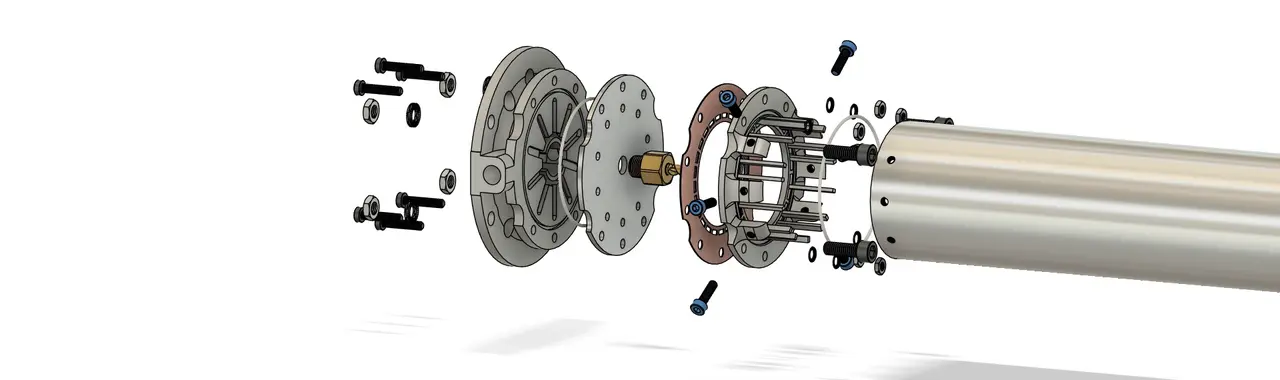
A fully modular architecture lets the nozzle, injector and fuel grain be swapped independently in under five minutes, so fuel formulations and injector configurations can be compared without refabricating structural hardware.

V1 · Tested.
- Injector manifold
- Fuel grain
- Coaxial shell gap
- Nozzle throat

Simulation
Sizing the nozzle in CFD.
Mesh-independent CFD simulations predicted about 1 kN of thrust at 550 psi chamber pressure, with about 99% nozzle efficiency from an 80% length Prandtl-Meyer contoured nozzle, closely matching analytical performance models.


Test
A 6-firing campaign; test 6 measured the peak.
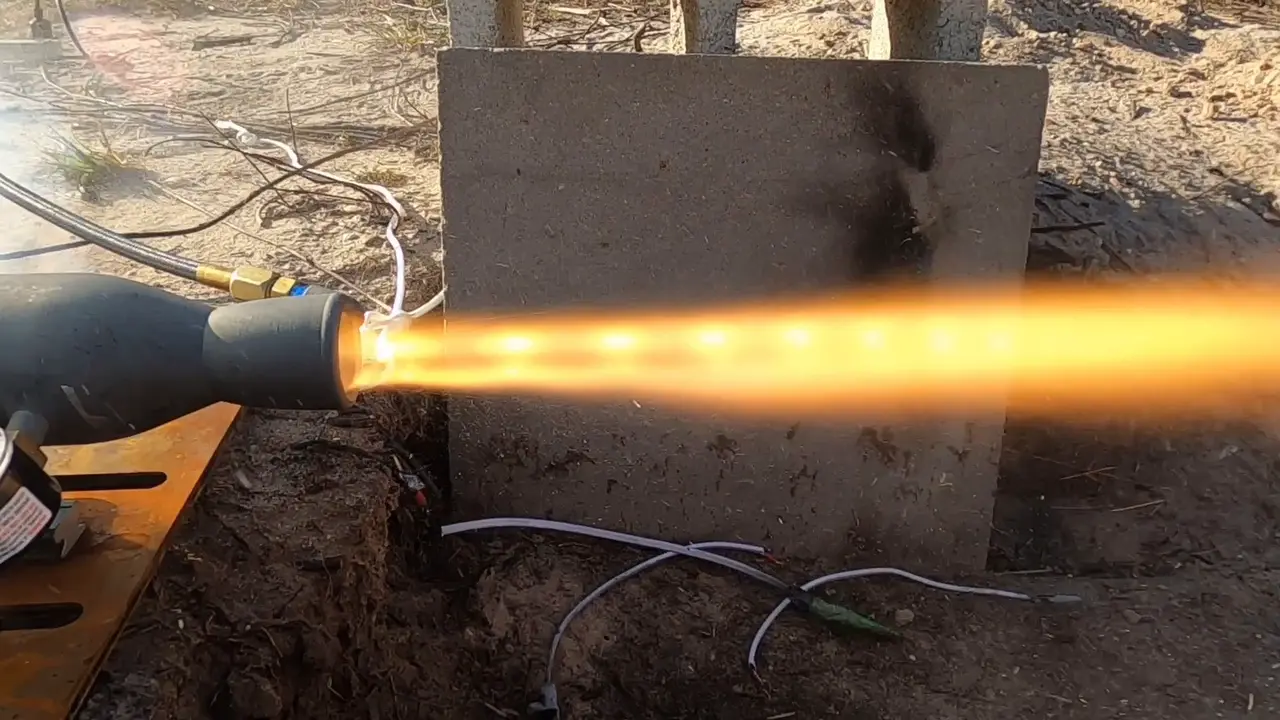
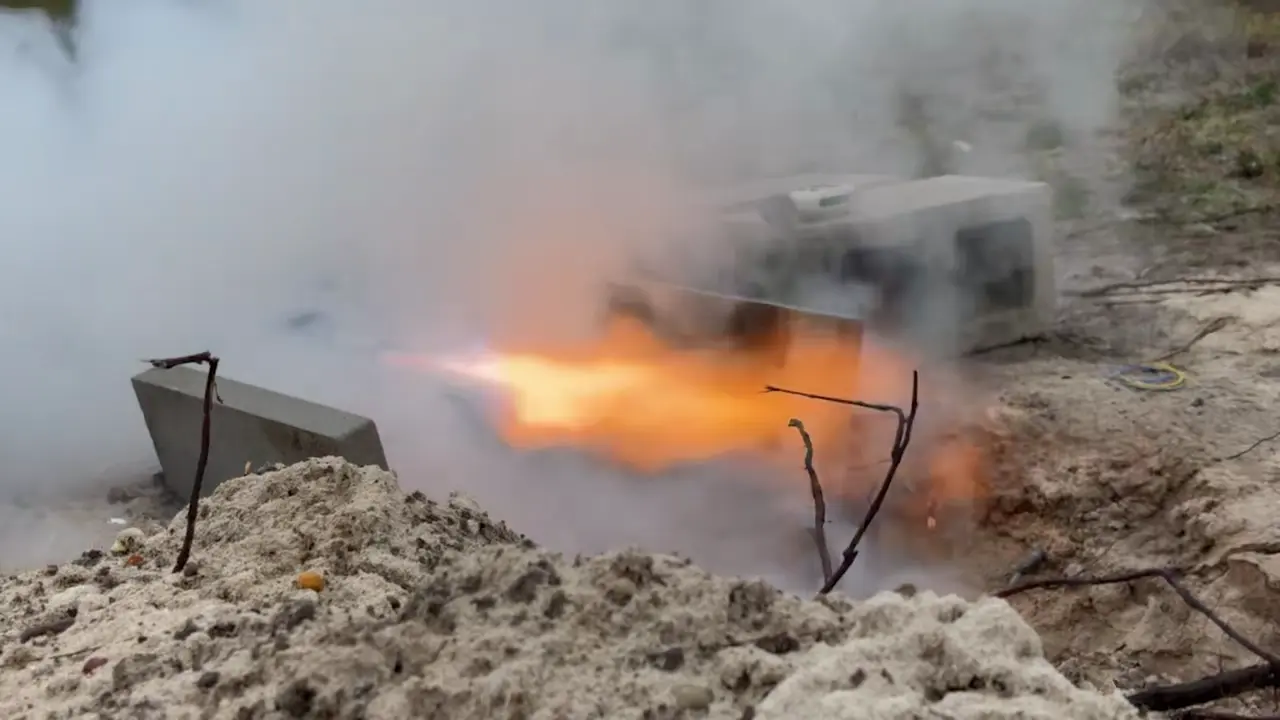
The complete system, including the engine, test stand, plumbing and data acquisition, was developed under strict cost and safety constraints and was robust enough for repeated hot-fire testing.
Results
What test 6 delivered.
Model vs test
1 kN
Design criterion, not a prediction or a measurement
916 ± 11 N
Hot-fire test 6, peak
205.9 ± 2.5 lbf
−8.4%
below the design target
| Parameter | Value | Condition |
|---|---|---|
| Peak thrust | 916 ± 11 N / 205.9 ± 2.5 lbf | Hot-fire test 6 of 6, measuredTest 6 video |
| Design peak thrust | 1 kN | Design criterion |
| Total impulse | 3,360 ± 60 N·s | Hot-fire test 6 |
| Specific impulse | 227 ± 12 s | Derived from test 6 |
| Predicted chamber pressure | 550 psi | CFD design point at about 1 kN thrust |
| Predicted nozzle efficiency | 99% | CFD, 80% length Prandtl-Meyer contour |
| Test 3 total impulse and chamber pressure | 807.74 N·s / 235 psi | Hot-fire test 3Test 3 video |
| Fabrication cost | $481.26 | Full engine |
| Hot-fire campaign | 6 firings | Engine V1 |
| Propellants | Nitrous oxide oxidizer and coolant | Regeneratively cooled |
| Manufacturing | Selectively laser-melted 316L stainless steel nozzle with channeled cooling; coaxial shell-cooled chamber | Modular nozzle, injector and grain |
Values here are rounded to their measurement uncertainty.
Gallery
Figures by kind
Hot-fire
(4)


Hardware
(4)


Simulation
(4)


Recognition
- NSS
Speaker at The National Space Society
Presented to industry experts on hybrid rocket engine and aerospike rocket engine research.